
 En
 English
 Français
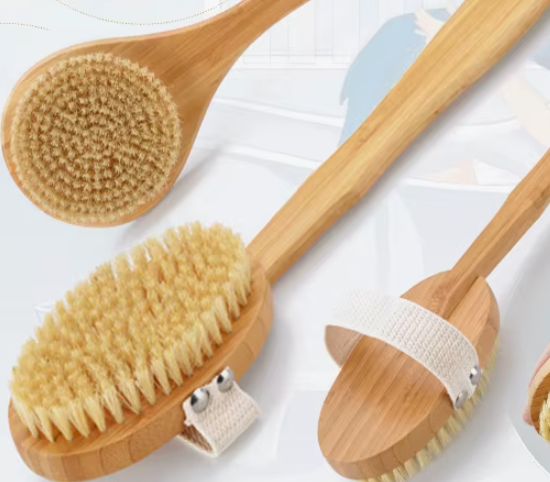
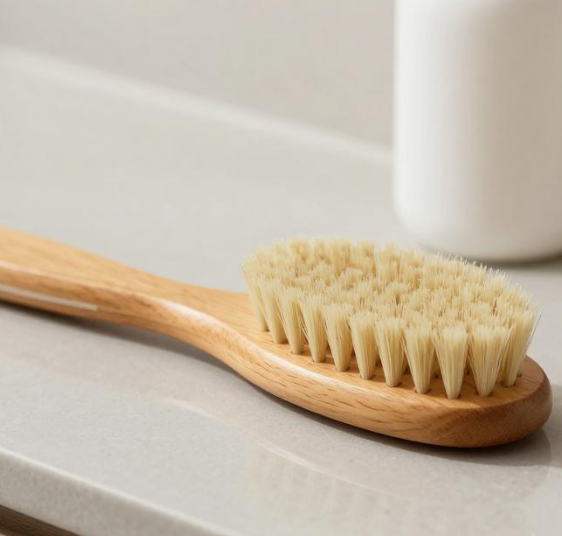
Sensitive skin can dry brush. What it usually cannot do is dry brush the way most tutorials demonstrate it: a stiff boar brush, firm pressure, five minutes a day, starting tomorrow. That routine is fine for resilient skin and reliably leaves reactive skin red, itchy and dotted with small bumps.
The version that works is narrower and more specific: a soft, densely packed natural bristle with rounded tips; pressure light enough that the skin never turns more than faint pink; sessions that start under two minutes and build up across four to six weeks; and a hard stop on any area that is inflamed, broken or actively flaring.
Below is what reactive skin actually tolerates, how bristle grade changes the outcome, and what buyers sourcing sensitive-skin dry brushes should write into a specification before placing an order.
Content
Who should skip dry brushing entirely
Friction is the entire mechanism, and friction is also the entire risk. Clinical commentary summarised by Medical News Today and SELF points to the same contraindications: active eczema, psoriasis plaques, sunburned or broken skin, and skin that is already very dry and cracked. On those surfaces, mechanical exfoliation widens a barrier defect that is already present.
Rosacea deserves its own line. Facial brushing with a body-grade bristle is the most common self-inflicted irritation in this category — the face needs a separate, much finer tool, or nothing at all.
| Skin situation | Verdict | Practical adjustment |
|---|---|---|
| Reactive but intact skin | Suitable | Soft bristle, twice weekly, under two minutes |
| Mild keratosis pilaris on arms | Usually suitable | Light pressure, moisturise immediately after |
| Eczema in an active flare | Skip | Wait until the skin is fully quiet again |
| Psoriasis plaques | Skip | Friction on a plaque can aggravate it |
| Facial rosacea | Skip on the face | Keep brushing to the body |
| Recent waxing, laser or shaving irritation | Wait 48–72 hours | The barrier is temporarily open |
| Retinoid or acid use | Adjust | Do not brush on the same evening |
| Very dry, cracked skin | Skip until repaired | Repair with emollient, then reintroduce |
A patch test tells you more than any label: one slow pass on the inner forearm, wait 24 hours, then look for heat, tightness or pinpoint redness. If the skin stays quiet, brush one shin, then one thigh. Tolerance is regional, not global — legs often accept what the chest will not.
For buyers mapping a range, our bath products for sensitive skin collection is grouped along exactly this ladder, from fine goat hair at the gentle end to firmer sisal in the middle.
Bristle grade matters more than bristle material
Two boar brushes can behave like two different products. The variables that decide how a brush feels are filament diameter, tip shape and tuft density — not the material name on the packaging. Natural bristles taper to a fine point, which is why a good boar brush glides; nylon must be mechanically end-rounded, and if it is not, the cut ends scratch.
The practical reading: a fine goat-hair brush forgives an imperfect stroke, while a stiff boar brush punishes it. Density matters just as much as softness — a sparse tuft puts more pressure per filament on a small area, so a densely packed soft brush is gentler than a sparse medium one.
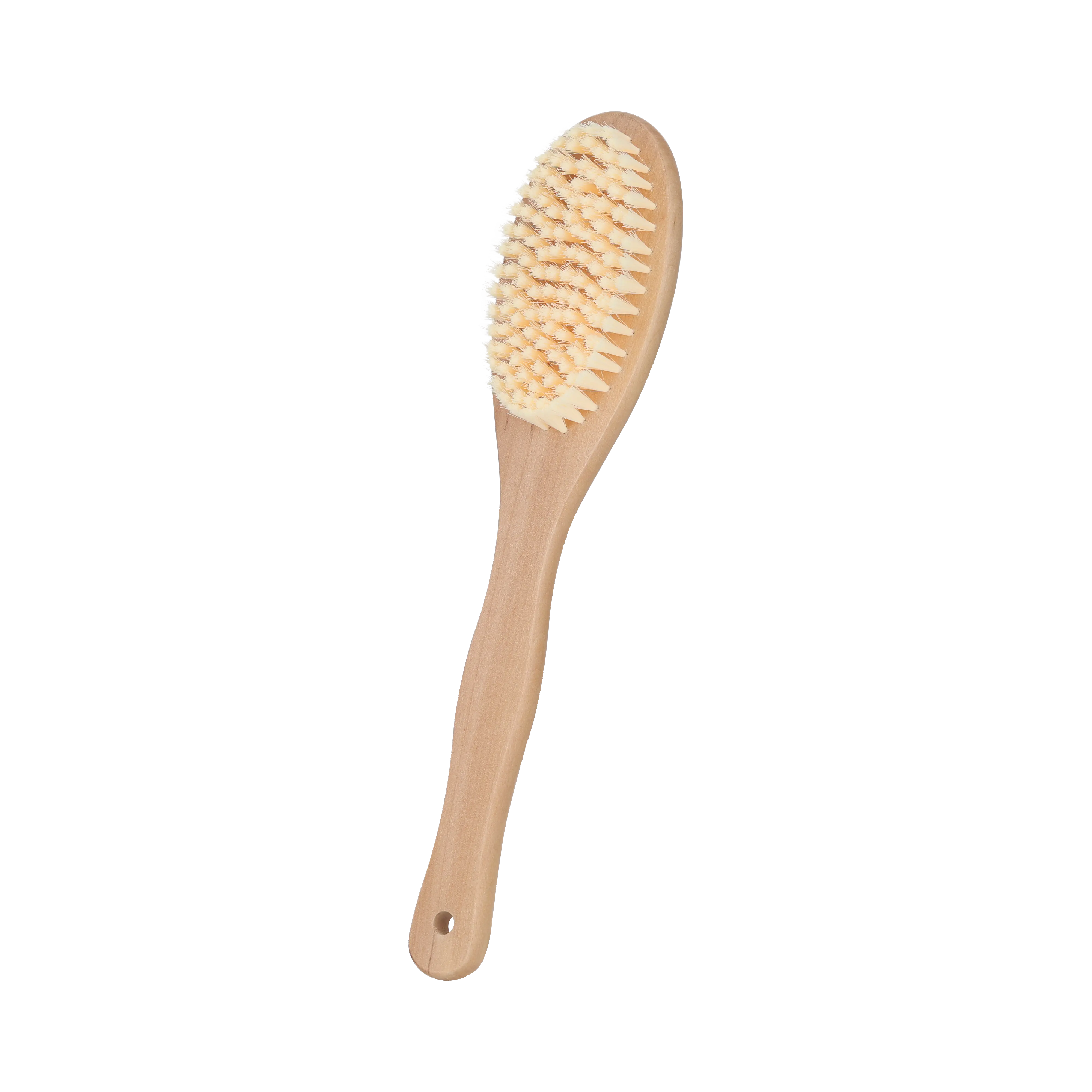 Short-Handled Wooden Bath Brush with Soft Nylon BristlesA gentle short-handled wooden bath brush with nylon bristles for sensitive skin, offering a soft option when comparing brush bristles and grip.View Product →
Textured skin conditions such as keratosis pilaris sit in the middle ground: they usually want slightly more exfoliation than pure sensitive skin, which is why a sisal or medium boar body brush works better there than the finest goat hair.
Pressure, direction and a build-up you can measure
Most irritation comes from three habits: too much pressure, too many passes, and starting at full frequency. Treat week one as calibration rather than treatment.
- Brush dry skin before showering, never wet — moisture softens the filaments and increases drag.
- Use one upward pass per zone, moving toward the heart: feet to knees, knees to groin, hands to shoulders.
- Cap the first week at two sessions of roughly one minute each, and add one minute per week.
- Keep the brush off the face, neck, décolletage and any area with broken skin.
- Shower, then moisturise within three minutes while the skin is still damp.
- Stop at faint pink. Anything that stings, or redness that lasts past 30 minutes, means back off for a week.
One myth to drop: dry brushing does not "detox" the body. The lymphatic system moves on its own; what brushing offers is temporary circulation and mechanical exfoliation. That is still worth having — it is simply a skin benefit, not a systemic one.
The anatomy of a gentle brush
Gentleness is built, not claimed. Four structural details separate a brush that sensitive skin can tolerate from one it cannot.
- 1 Handle. A bamboo or beech handle of 380–420 mm lets you reach the back with the wrist relaxed instead of pressing harder.
- 2 Sealed base and drainage. A water-based sealed base stops swelling and splitting; a drainage hole keeps the head dry between uses.
- 3 Tuft density. Dense packing spreads load across more filaments, which lowers pressure per contact point.
- 4 Rounded tips. Natural bristles taper; nylon must be end-rounded. Exposed staples or trimmed blunt ends are the usual cause of scratching.
What buyers should write into a specification
For private-label and wholesale programmes, "soft" is not a specification. A workable sensitive-skin brief names filament material and diameter, tip treatment, tuft density, base sealing method, handle species, and the packaging claim the product will carry.
The green shape is fine goat hair, the brown is soft boar, the dashed shape is sisal. No single material wins every axis: goat hair leads on softness and trails on cost, boar leads on durability, sisal is the balanced middle. A range usually needs two of the three.
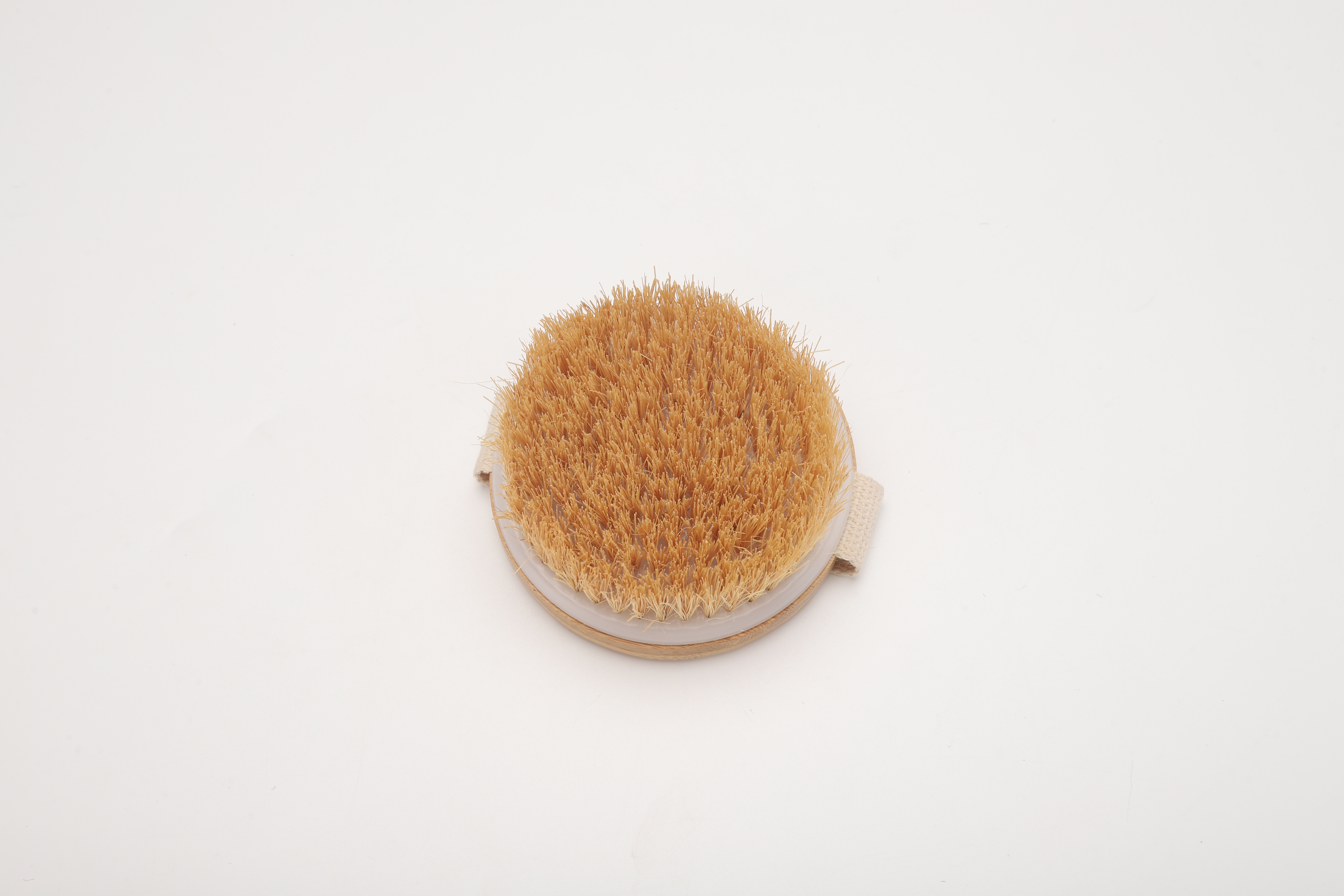 Bamboo Sisal Handheld Bath BrushA dense, integrally planted sisal and bamboo handheld brush with resilient bristles and strong cleaning action, sitting between soft and stiff options.View Product →
Sisal is the usual middle tier for buyers who need one brush that serves both normal and reactive skin. Our natural sisal fiber brushes run at a medium filament grade with rounded tips, which keeps them inside the tolerance band for most body skin.
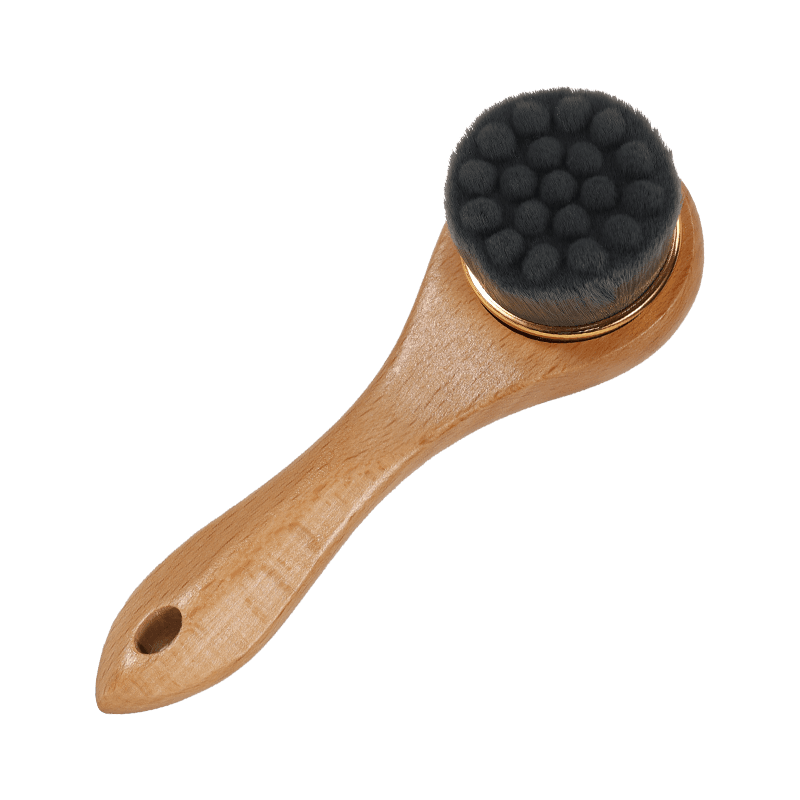 Natural Goat Bristle Bamboo Facial Cleansing BrushA bamboo facial cleansing and dry-brushing brush for face and neck; the page names goat bristle but also mentions boar hair, so verify bristle details.View Product →
Two more items belong in the brief: a documented tip-rounding method (mechanical or flame), and a moisture test after 24 hours of soaking, because a sealed base that fails the soak test is what turns a soft brush stiff in a few weeks.
Cleaning and replacement
- Wash weekly with lukewarm water and a drop of mild soap; rinse until the water runs clear.
- Dry bristle-down in open air, never on a radiator or in direct sun.
- Replace every 6–12 months — filaments flatten with use, and a splayed brush applies uneven pressure.
- Do not share a dry brush, and do not return it to a drawer while damp.
Frequently asked questions
- Q1. Is dry brushing good for sensitive skin?
It can be, at a lower intensity than standard advice suggests. Use a soft, dense natural bristle, one pass per zone and sessions under two minutes at the start. Skip it entirely during an eczema or rosacea flare.
- Q2. How often should you dry brush sensitive skin?
Twice weekly is the normal ceiling. If you tolerate it well after six weeks, a third short session is reasonable; daily brushing rarely adds benefit and often causes irritation.
- Q3. What is the best dry brush for sensitive skin?
Look for fine natural bristles with rounded tips, dense tuft packing and a sealed wooden base with a drainage hole. Goat hair is the softest common option; medium sisal is the practical compromise.
- Q4. Can dry brushing help keratosis pilaris?
Moderate exfoliation often smooths the bumps temporarily, but the effect comes from reduced scale build-up, not from brushing harder. Pair it with an emollient rather than increasing pressure.
- Q5. Does dry brushing really help lymphatic drainage?
Lymph moves through muscle contraction and breathing, not through brushing. Dry brushing improves surface circulation and exfoliation; any "detox" claim attached to it is not supported.
- Q6. What should a buyer check in a wholesale dry brush supplier?
Bristle grade and diameter, tip treatment, base sealing, handle species and certification, plus whether private-label and custom-logo options are handled in-house rather than subcontracted.